
Trauma Ethics
The Skill No One Is Teaching

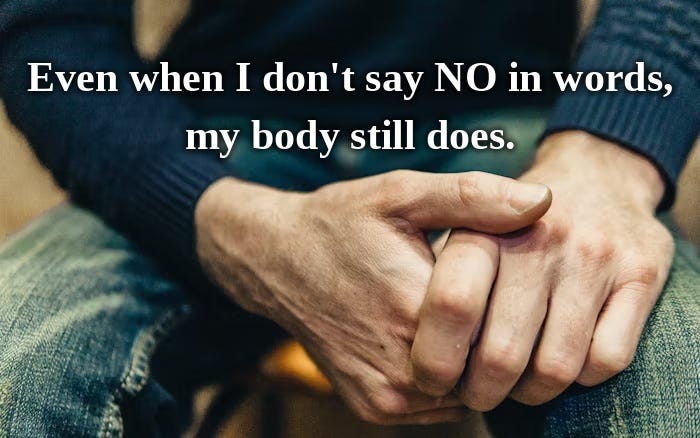
For several years I sat on the ethics board of a psychology training program. Complaints came in about many things — boundary violations, inappropriate disclosures, theoretical disagreements. But when I looked closely at what was actually happening underneath each complaint, I kept finding the same thing.
The therapist couldn’t read their client.
Not in the obvious ways — not cruelty, not malice, not even indifference. Something more subtle and more dangerous: they couldn’t track whether the person sitting across from them was actually consenting to what was happening between them. They were following their model. They were applying their theory. They were trying to help. And in doing so, they were missing the river of information the client’s body was constantly sending.
That is a trauma ethics problem. And almost no one is teaching it.
———
I know this from the inside.
I have been a client. A good one, I think — curious, willing, not particularly defended. And I remember sitting with a therapist I respected, someone skilled, and hearing them say something that landed slightly wrong in me. A small hesitation rose. Not a rejection — more like: I’m not quite there yet. Part of me isn’t on this road.
I didn’t say anything. I nodded. I let them continue.
Why? Not because I was weak or passive. Because they were the authority. Because I had come to them for help. Because something in me believed — the way we have all been trained to believe — that their knowing superseded my hesitation. That my uncertainty was the problem to be resolved, not information to be honored.
That is not a pathology unique to trauma survivors. Most of us do this to some degree whenever we are in a power differential. We fawn. We comply. We make the helper feel helpful. But for people who have been traumatized — people who learned early that their no was not safe, not welcomed, not even visible — this compliance can run very deep. They have practiced it for years. They are fluent in it. And they will bring that fluency right into the therapy room.
Which means the therapy room can become, without anyone intending it, another place where their body says one thing and they say another.
———
A client came to me some years ago. During our work together, she mentioned a male relative who would always reach out to hug her when they met. She didn’t like it. But as she said the words, I watched her body: her shoulders pulled in, her torso curved slightly forward, as if she were trying to close — like a mollusk, drawing back into its shell.
I didn’t move past that. I asked her what it was like to be in her body as she remembered it. She let herself feel the cringe. Let it deepen. Her shoulders curled further in, her breath shortened, her whole body spoke a clear and ancient language: get away from me.
When I asked for words, she said: Get off of me. You’re disgusting.
She would never say those words to him. Maybe she should, maybe she shouldn’t — that depends on many things. But she needed to know that those words existed inside her. That her body had always known.
Then, some time later, she asked me something that stopped me.
When will I be able to be open to his hugs?
Read that question carefully. She was not asking when he would change. She was not asking when it would be easy to say no. She was asking when she would be able to override what her body knew — as if her body’s response were the problem. As if the cringe were the thing to be fixed.
That is shame talking. Shame had convinced her that her somatic truth — the closing, the recoiling, the get off of me — was a deficiency in her rather than a precise and intelligent response to someone violating her space.
The same thing happens in therapy. Clients come in already ashamed of their hesitations, their distrust, their inability to simply open up and heal. They ask: How can I not trust my therapist? Don’t I need to trust them to get better?
I always say: begin by bringing your distrust forward.
Because if a therapist is working to get you to trust them — if the therapeutic project is, in any way, the overcoming of your hesitation — then something has already gone wrong. The therapist is, however gently, asking you to override your somatic authority. And if you were traumatized by someone who did exactly that, you are now in a room that rhymes with the original wound.
The distrust is not the obstacle. It is the beginning of the work.
The skill required to avoid all of this is not primarily theoretical. It’s about seeing, witnessing.
There are always two rivers of information flowing from the person you’re working with. The first is the content — the story they’re telling, the issue they’ve named, the words they’re using. The second is something else entirely. It’s in the quality of the breath. The way the body leans toward or pulls back. The giggle that comes through tears. The slight brightening of the eyes. The almost imperceptible tightening of the jaw.
This second river is saying, constantly, without words: Yes, you’re on the right spot. No, you’ve moved away from it. Nothing you’re doing is reaching me right now. Keep going. Don’t stop here.
Trauma survivors have often learned to say yes when they mean no. Which means if you are only listening to the first river, you can miss the second one.
I had a client who came in with her partner, who was making accusations against her. At one point I noticed she kept glancing toward the door. Not dramatically. Just: a look, and then back.
I said: You’re looking at the door.
She said: I have to stay here to work this out.
Her words said I have to stay. Her body was looking for the exit.
If I had not named that — if I had taken her words at face value and continued with the session — we would have been building on sand. Any work we did would be unsustainable, because she was not behind it. Worse: pushing someone to do therapeutic work when part of them is already at the door can be its own form of violation. You are asking them to stay in a situation their body is trying to leave.
That is not therapy. That is a reenactment. Retraumatization.
———
Thirty-six years ago I was in Australia, studying with Arnold Mindell — one of the great therapeutic minds of the twentieth century, my teacher for thirty-five years. After a session he had done with a client, he played us a recording of the first ten minutes and walked us through it.
In those ten minutes, he showed us four distinct moments where the client’s body was saying no — where their minimal cues, their hesitations, their somatic signals were communicating clearly: I’m not on this road with you.
And in two of those moments, Arnie had kept going anyway.
Arnie Mindell. Master therapist. Four moments in ten minutes.
He wasn’t showing us this as self criticism. He was showing us because this is the work. You will miss signals. Fortunately, the client will keep sending them. Your job is to develop the awareness to catch more them over time.
This is a skill. Not just intuition, not just sensitivity, not just years of accumulated wisdom. A learnable, practicable, refineable skill. You can watch recordings. You can slow things down. You can learn to see what a congruent yes looks like in the body — and what it looks like when someone says yes while their jaw tightens slightly, while their words come with a half-beat of hesitation, while something behind their eyes goes quiet.
When you see that gap between the word and the body, you don’t push forward. You slow down. You make an inquiry. You follow the body even when the words are pointing somewhere else.
That attunement — that moment-to-moment tracking of whether your client is actually with you, actually consenting, actually present in their own process — is not a supplement to trauma ethics.
It is trauma ethics.
Not a set of rules imposed from outside. Not a checklist. A living practice of awareness and inquiry.
The body always knows. Our job is to learn to listen.
———
I’ll be teaching this work live in London and Amsterdam this June — a precise, practice-based approach to reading somatic signals as a form of trauma ethics. Comment interested if you want to know more.
“David Bedrick provides a deep investigation of shame, the most debilitating of our mind states, and offers a workable, practice-based, and accessible path to divesting ourselves from it.” — Gabor Maté, MD