
Collapse as Healing
When Going Down Is the Medicine

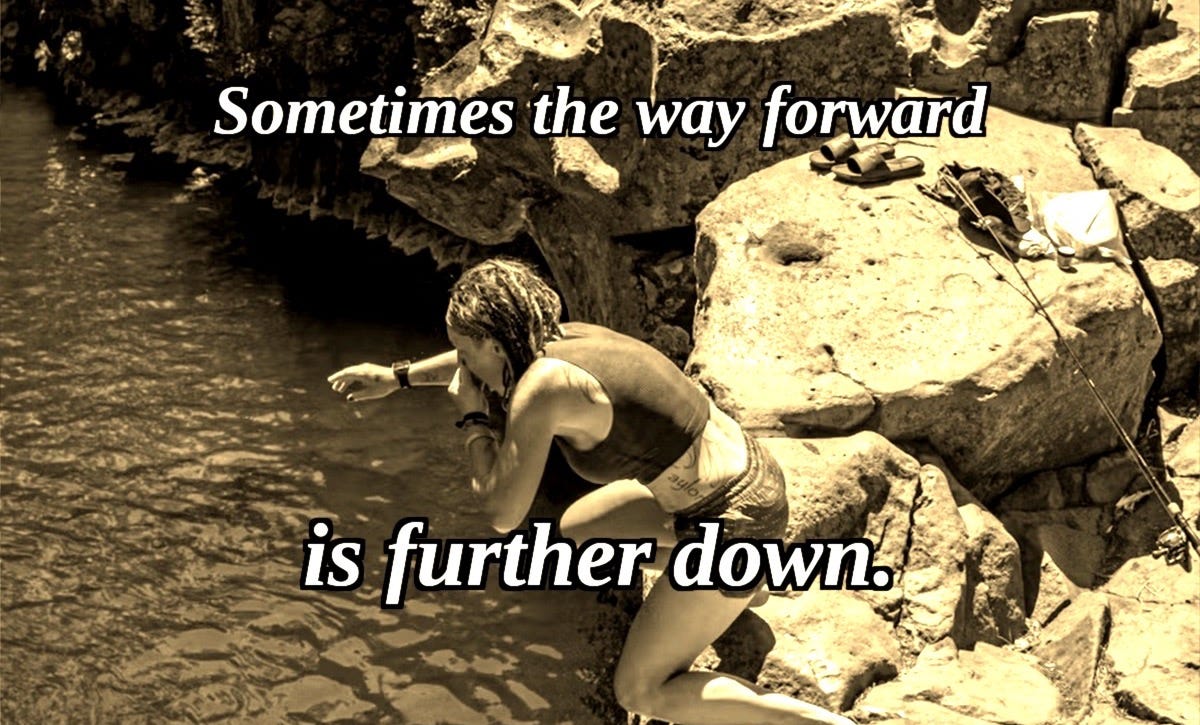
She came in distraught about a pattern.
Her marriage of fifteen years had ended, and she was doing the work of getting through it. Some days she felt genuinely well – clear, forward-moving, almost surprised by her own resilience. But then she would collapse. Not defeated exactly. Not crushed. Collapsed was her word. And she was critical of herself for it, ashamed of the pattern, convinced she should be able to stay up and not keep going down.
This is what most people bring to therapy around grief and depression. The down is the problem. The goal is to stay up. The therapist’s job, in the conventional view, is to lift.
We didn’t lift.
———
We went into the collapse. Not around it, not above it – into it.
She began showing the pattern with her hand. Up, then down. Up, then down. The rhythm of her inner life since the marriage ended. And as we stayed with it, as we asked her to let the movement be what it wanted to be rather than what she thought it should be, something began to change.
The downward motion started getting more intense.
Her hand went higher before it came down. The drop became faster. More committed. And then she was standing — supported by the students working with her — her arm reaching up as high as it could go and then swooping down with full speed and full intention.
Not falling. Not dropping. Diving.
Like a falcon going for its prey.
She was lit up. Smiling. Excited. She kept doing it — reaching high, swooping down — and the room felt it. Something that had looked like collapse was revealing itself as something else entirely. A capacity. A skill. A way of moving through the world that had been framed as her problem and was actually her power.
———
This is what the Unshaming Way does with what the conventional world calls symptoms.
It doesn’t ask: how do we get rid of this?
It asks: what is this? What does it know? What does it want?
Because when a person is victimized by an energy — when they feel subject to something painful, something they didn’t choose, something that keeps happening to them — the natural response is to want relief. That makes complete sense. Of course she wanted to stop collapsing. Of course she wanted to feel more stable. That desire is real and worth honoring.
But underneath it, the body was saying something else. The shadow river was running.
And what it was saying, when we finally followed it all the way, was this:
I want to dive. I have always wanted to dive. Don’t mistake my diving for falling.
Then came the harder question.
When we talked about the diving — about what made it difficult — she said: when I’m down there, I get stuck in the self-loathing.
Yes. There it is.
Because the dive doesn’t end in open water. It ends in the place where something in her says you’re worthless, you’re nothing, you’re disgusting, you failed. The self-loathing that lived in the marriage, that maybe lived long before the marriage, that certainly has not left just because the marriage ended.
And I said: then we dive into that too.
Not to wallow. Not to confirm it. But because the self-loathing is not separate from the grief — it is the grief, or a large part of it. It is the accumulated weight of years of a self that was not fully free, not fully seen, not fully allowed to dive when it needed to dive.
If she carries that self-loathing untouched into the next chapter of her life, it will meet her there.
It will be in the next relationship before she even arrives.
It will tell her the same things it has always told her, in a new place, with a new person, at a new table.
But if she dives into it — if she lets it speak its worst, amplifies it, gets to know it all the way down — then something becomes possible. Not the end of the self-loathing, necessarily. But a relationship with it that isn’t pure victimization. A woman who has been to the bottom of that particular sea and come back up.
A falcon who knows how to dive.
Her body knew this before she did. That’s what the shadow carries — information the speaking self hasn’t caught up to yet.
The collapse wasn’t the problem. It was the map.
David Bedrick is the founder of The Unshaming Way — a practice built on the conviction that what ails us often knows more than what cures us. He is the author of five books and trains therapists and coaches to do the same.
Your work is so revolutionary David and I love you so much. I read this woman's story and I feel it in my chest and I want to be in an empty room so that I can let my hands move, let my body move outside of the roles that it plays. Completely free. ❤️